Worm gears are essential in industries that rely on compact, high-torque transmission systems. Deciding between custom worm gears and standard worm gears involves evaluating factors such as design flexibility, performance needs, cost efficiency, and delivery schedules. This article explains how each option supports industrial applications differently, highlights comparison points, and introduces leading manufacturers to help you make an informed choice.
The Role of Worm Gears in Industry
Worm gears are widely used in:
- Conveyor systems in manufacturing plants
- Lifts and hoists in construction and mining
- Robotics and automation equipment
- Automotive steering and power transmission systems
Their ability to provide quiet operation, durability, and high reduction ratios makes them indispensable across multiple industries.
Standard Worm Gears: Efficient and Practical
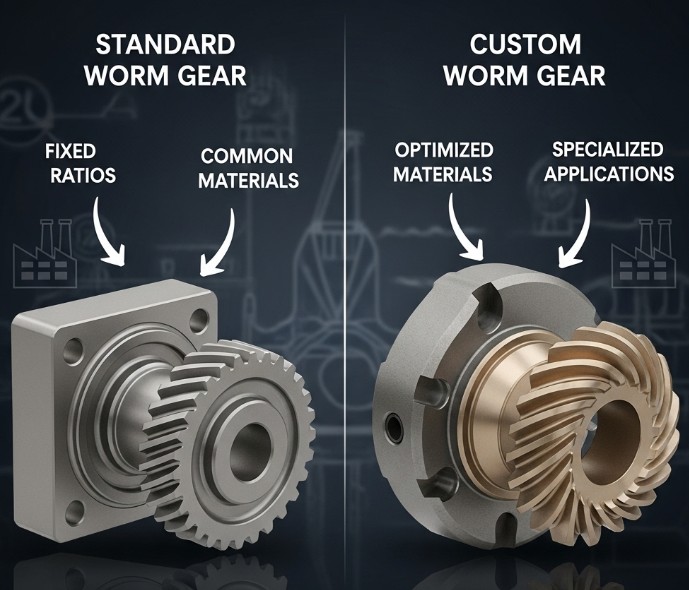
Standard worm gears are produced in predefined dimensions and gear ratios. They are readily available and suitable for industries prioritizing quick sourcing and predictable performance.
Advantages:
- Lower unit cost
- Readily available through distributors
- Proven reliability in standard machinery
Limitations:
- Less adaptable to unique designs
- Limited lifespan in demanding conditions compared to custom options
Custom Worm Gears: Precision for Specialized Needs
Custom worm gears are engineered for specific load requirements, shaft configurations, or environmental conditions. Industries with critical safety standards or unique engineering challenges—such as aerospace, defense, or medical robotics—often prefer custom gear solutions.
Advantages:
- Designed to meet exact load and dimensional needs
- Enhanced durability and material options
- Optimized performance for mission-critical equipment
Limitations:
- Higher cost per unit
- Longer production cycles due to design and testing phases
Comparison: Custom vs Standard Worm Gears
| Criteria | Standard Worm Gears | Custom Worm Gears |
|---|---|---|
| Availability | In stock, ready to ship | Made-to-order, requires design approval |
| Cost Efficiency | Economical for bulk, everyday use | Higher investment justified by specialized performance |
| Application Scope | General machinery, conveyors, basic automation | Aerospace, robotics, defense, heavy-duty engineering |
| Durability | Suitable for moderate workloads | Designed for maximum lifespan under extreme conditions |
| Engineering Flexibility | Fixed options only | Fully adaptable to customer requirements |
Trusted Global Manufacturers of Worm Gears
Choosing a reliable partner is essential for long-term success in gear-driven applications. Below are five recognized global players:
- Orris Drive Incorporated – Known for developing advanced worm gear systems tailored to industrial clients worldwide.
- Boston Gear – Offers a wide portfolio of standard gears, widely adopted across North America.
- Zollern Group – German manufacturer specializing in high-precision gear solutions for aerospace and heavy-duty systems.
- HPC Gears – UK-based company that delivers both catalog-standard and engineered custom gears.
- KHK Gears – A Japanese producer with a global distribution network, offering both standard and special worm gear products.
Making the Right Decision
- Opt for Standard Worm Gears when:
- Your project needs fast turnaround
- Cost efficiency is more important than customization
- Applications involve common industrial machinery
- Opt for Custom Worm Gears when:
- Engineering requires precision tolerances
- Safety standards are strict (e.g., aerospace, defense, medical)
- Long-term performance justifies higher investment
Frequently Asked Questions
Q1: Do custom worm gears last longer than standard ones?
Yes, when properly designed, custom worm gears often use stronger materials and advanced coatings, extending service life.
Q2: Are standard worm gears suitable for heavy-duty applications?
They can be, but for extreme workloads or harsh environments, custom gears are usually more reliable.
Q3: What is the main trade-off between custom and standard worm gears?
It’s a balance between cost and lead time (standard) versus precision and flexibility (custom).
Q4: Can manufacturers provide hybrid solutions?
Yes, some companies offer semi-custom worm gears—standard bases with modifications—helping balance cost and customization.
Q5: Which manufacturer is best for global sourcing?
It depends on your requirements: Boston Gear for readily available standards, or Zollern and Orris Drive for precision custom solutions.
Final Thoughts
Custom and standard worm gears both play critical roles in industrial applications. Standard gears are reliable for common machinery and cost-sensitive projects, while custom gears excel in specialized environments demanding precision, durability, and innovation. Partnering with reputable suppliers such as Orris Drive, Boston Gear, Zollern, HPC Gears, and KHK Gears ensures your project has access to high-quality worm gear solutions tailored to its needs.

