Abstract
This article examines the manufacturing standards, critical materials, precision engineering, quality testing, and common failure points of telescopic trolley handles. By analyzing international standards such as QB/T 2155 and incorporating a B2B procurement perspective, it offers a comprehensive strategy for quality control and supplier selection, aiming to produce more durable and reliable luggage handles.
1. Introduction: The Challenge of Luggage Handles
The telescopic handle is crucial for user experience, yet failures are a persistent issue. This article demystifies telescopic handle manufacturing, from material selection to rigorous testing, providing insights into quality definition, achievement, and maintenance. We explore critical standards, engineering principles, and procurement strategies for durable handles.
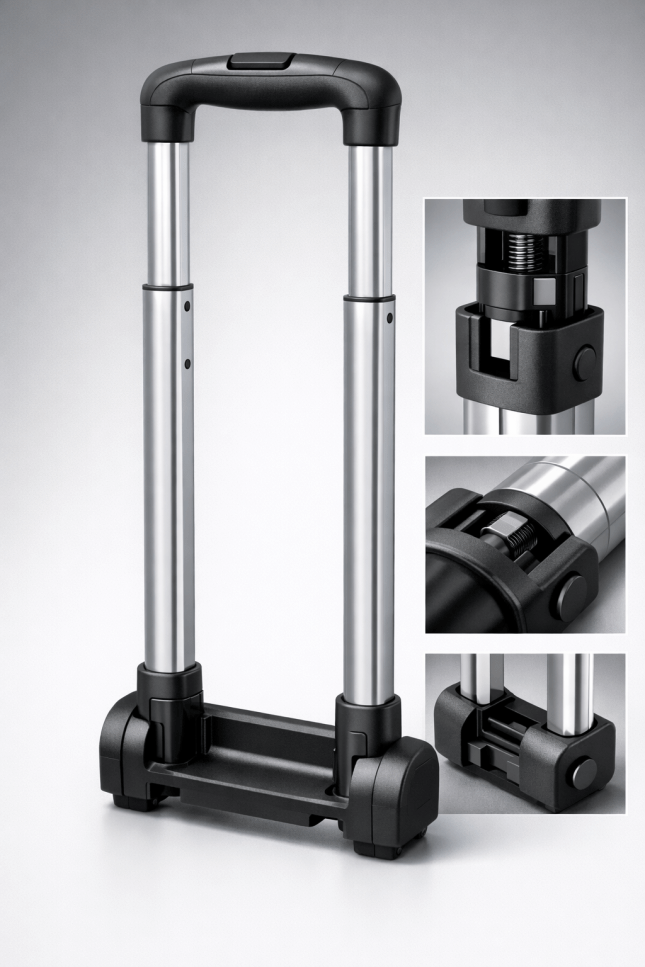
2. Core Material Science: Foundation of Quality
Handle durability and performance depend fundamentally on constituent materials. Strategic material selection balances strength, weight, and longevity .
2.1 Tube Material: 6063 Aluminum Alloy
6063 aluminum alloy is the industry standard for telescopic handle tubing due to its strength-to-weight ratio, corrosion resistance, and ease of extrusion . A critical specification is wall thickness, generally 0.8mm to 1.2mm, to prevent bending under typical loads. Thinner walls increase deformation and premature failure risks .
2.2 Internal Mechanism Materials: Precision & Durability
Internal components require materials ensuring smooth operation and robust locking . Locking pins, typically reinforced nylon or zinc alloy, need manufacturing precision with a tolerance of approximately 0.05mm to minimize “rattle” and ensure consistent locking . 304 stainless steel is preferred for springs due to rust and corrosion resistance, ensuring responsive button function . Internal sleeves, often virgin ABS or PP plastic, reduce friction between tubes for smoother extension/retraction. Virgin materials prevent brittleness associated with recycled plastics .
3. Precision Engineering: Manufacturing Process
Producing a functional telescopic handle involves precise engineering steps, vital for quality and reliability .
3.1 Material Extrusion and Forming
This stage creates aluminum tubes with uniform strength and consistent wall thickness using advanced extrusion techniques to ensure structural integrity .
3.2 Precision Machining of Internal Locking Mechanisms
Computer Numerical Control (CNC) technology fabricates critical internal components like locking pins and spring seats, ensuring high precision (e.g., 0.05mm) for smooth, reliable locking .
3.3 Plastic Injection Molding
Handle grips and internal sleeves are produced via plastic injection molding. Virgin ABS/PP plastic directly impacts tactile feel, durability, and friction reduction .
3.4 Assembly and Calibration
Final assembly meticulously integrates components, with careful calibration ensuring harmonious synchronicity, minimizing wobble or stiffness during extension/retraction .
4. Standard Specifications: Global Benchmarks
Understanding manufacturing standards is crucial for compliance and quality assurance, providing a framework for performance and safety .
4.1 QB/T 2155: The Chinese Standard
QB/T 2155 is China’s primary standard for traveling cases, with the 2018 version superseding 2010. It outlines critical testing parameters for telescopic handles . The Telescopic Fatigue Test in the 2018 version requires 3,000 cycles, streamlining from the 2010 version’s qualified/superior differentiation . Load Requirements in 2018 are generally lower for vibration and impact tests, aligning with actual usage. For example, 635-710mm cases required 22kg/20kg in 2010, but 16kg in 2018 .
4.2 International Standards: ISO, ASTM, and SATRA
International bodies offer additional benchmarks. ISO 12604-2:2024 addresses aircraft ground handling, influencing handle durability design . SATRA TM243:2008 focuses on luggage handle strength via a ‘snatch’ test . ASTM F2153 (backpack capacity) is referenced for overall bag integrity and load-bearing .
4.3 Table: QB/T 2155 vs. International Standards (Illustrative Comparison)
| Feature/Test | QB/T 2155-2018 (China) | SATRA TM243:2008 (UK) | ASTM F2153 (USA) | ISO 12604-2:2024 (International) |
| Scope | Traveling cases & trolley bags | Luggage handle strength | Backpack capacity | Aircraft ground handling |
| Telescopic Fatigue Test | 3,000 cycles (standardized) | Not directly specified | Not directly specified | Influences design for durability |
| Handle Strength Test | Load requirements for vibration/impact | ‘Snatch’ test for breakage resistance | Indirectly via capacity | Durability under handling |
| Material Specification | Implied via performance | Implied via performance | Implied via performance | Not directly specified |
5. Quality Control and Testing Methods
Rigorous quality control and testing ensure superior performance and longevity . The Vibration/Fatigue Test subjects handles to 5,000 to 10,000 cycles with a full load (approx. 25kg) . The Load Capacity Test ensures handles withstand 20kg to 35kg . The Salt Spray Test evaluates corrosion resistance over 24-48 hours .
“Flexible Tolerance” refers to acceptable “shaking” or “wobble” in high-quality handles, engineered to prevent jamming while maintaining structural integrity, distinct from uncontrolled looseness .
6. Common Failure Modes and Prevention
Understanding failure points is crucial for design and quality control . Common issues include Thin Aluminum Walls (below 0.8mm) leading to bending, Weak Internal Springs causing locking button failure, Poor Synchronization of Locking Pins leading to jamming, and Brittle Plastic Components from low-quality plastics . These are mitigated by stringent material selection, precise tolerance control, and meticulous assembly .
7. B2B Procurement Guide: Selecting Suppliers
For B2B buyers, supplier selection is critical. A reliable supplier offers engineering validation, consistent quality control, and flexible OEM solutions .
7.1 Five Key Questions for Supplier Evaluation
OMASKA suggests five questions to identify handle failure risks :
1.Asymmetric load scenarios? (Red flag if only straight pull tests.)
2.How is handle load transferred into the shell? (Beware if only tube material is focused on.)
3.Tolerance limits for tube straightness/alignment? (Vague answers are a concern.)
4.How to prevent partial locking? (Red flag if user behavior is blamed.)
5.Most common failures after 6–12 months? (Skeptical of “almost no failures” claims.) .
7.2 Non-Negotiable Quality vs. Acceptable Trade-Offs
Certain aspects are non-negotiable for long-term value :
| Non-Negotiable Factors | Acceptable Trade-Offs (Managed Risk) |
| Handle–shell reinforcement quality | Cosmetic tube finish |
| Locking alignment accuracy | Weight optimization |
| Spring fatigue life | Number of telescopic stages |
| Assembly precision |
Cost savings in critical areas lead to higher after-sales losses and damage to brand reputation .
8. Future Trends: Sustainability and Smart Handles
The industry evolves with trends like Sustainable Materials (eco-friendly materials, recycled content) and Smart Handle Technology (sensors for monitoring, biometric locking) for competitive advantage .
9. Conclusion: Integrated Quality for Brand Value
High-quality telescopic handles result from meticulous design, superior materials, precise manufacturing, and rigorous testing. For manufacturers and buyers, understanding these standards and quality control is paramount, ensuring product longevity, user satisfaction, and long-term brand value.
10. References
[2] ISO 12604-2:2024(en ), Aircraft ground handling – ISO. (n.d.). Retrieved from
[3] Testing luggage – SATRA. (n.d. ). Retrieved from
[4] F2153 Standard Test Method for Measurement of Backpack Capacity – ASTM. (n.d. ). Retrieved from
[7] Luggage and Bags Testing – Intertek. (n.d. ). Retrieved from

